
Know the bumps before you board.
The leading app in turbulence prediction. Get forecasts for your exact flight so you can board with confidence.

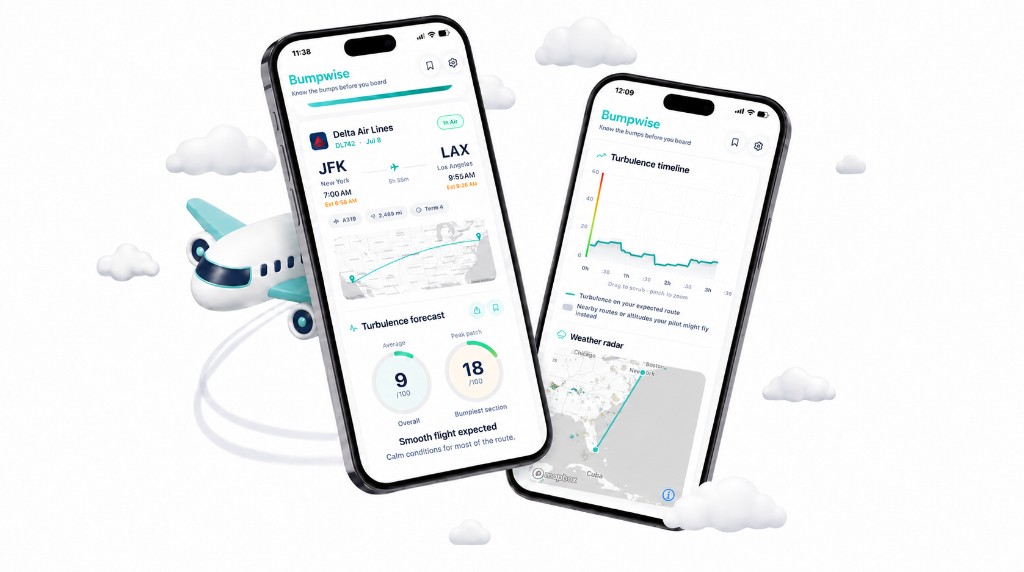

Pioneers in turbulence intelligence
Our Technology
No consumer app had fused operational aviation forecasting with live ground truth until Bumpwise. We blend the model air traffic control uses, live pilot reports, real time aircraft telemetry, and a physics based engine into one honest, per minute intensity timeline.
Every other turbulence tool mostly renders a government map and asks you to eyeball your route. Bumpwise built the fusion engine airline dispatchers effectively run by hand, automatically, before you board.
7
Independent data sources
3 min
Timeline resolution
NOAA first
When EDR coverage is available
±30 nm
Route corridor coverage
Twelve signals. One fused score.
Each spoke is an independent measurement the engine pulls, weights, and reconciles for every flight, not a marketing checklist. Hover a node to see how that layer works. Competing apps typically plot one or two of these; Bumpwise is the only consumer product pulling from all twelve in real time.
Built on what pilots and ATC already trust
Where NOAA’s operational EDR forecast is available, Bumpwise defers to it as the primary signal, the same Eddy Dissipation Rate model air traffic control itself uses. Live PIREPs, advisories, and physics fill the rest with capped trust so no single source can overwhelm the truth.
Hover a spoke on the web to explore each signal.
How a forecast is built
From raw atmosphere to a cabin ready timeline, the work a dispatcher would do, automated end to end.
- 01
Ingest seven sources
NOAA GTG, HRRR/GFS, PIREPs, AIRMETs/SIGMETs, convective advisories, FlightAware schedules, and ADS B telemetry, each contributing a different kind of truth.
- 02
Build the flight corridor
Sample the centerline and ±30 nm edges. Assign each waypoint an ETA from flight progress so forecasts match when you will actually be there.
- 03
Run the physics engines
Surface wind and gust intensity for takeoff and landing. Upper intensity from vertical shear and CAT proxy for cruise, plus horizontal shear between waypoints.
- 04
Fuse with operational truth
Where NOAA EDR is available, the government model leads and the Bumpwise heuristic stays in a supporting role so live PIREPs and advisories can still register. Trust ceilings keep any single layer from dominating.
- 05
Render the per minute timeline
A smooth intensity timeline across the flight, then adjusted for aircraft feel. Average, peak patch, and a plain English ride sentence. Nothing is a vibe.
A per minute intensity timeline
The engine builds an intensity value throughout the flight, then smooths it across a rolling window. Each phase starts from a calibrated baseline. Takeoff and landing run hotter than cruise because ground adjacent air is inherently rougher, then layers in live physics.
Average stays honest. Peak patch never hides.
The average is the mean of the whole timeline, never inflated by spikes. The peak patch is the single bumpiest expected minute, always matching the chart’s high point. Hover a phase to see how that segment is scored.
Corridor, not a city weather guess
Bumpwise never looks up “the weather for a city.” It constructs the actual flight, a time resolved corridor through the atmosphere, and scores each point with the forecast for the moment the aircraft will be there. Hour 3 of a transcontinental flight is scored with hour 3’s forecast, not departure time weather.
The NOAA EDR blend
Where the GTG decoder returns real EDR for a route segment, NOAA’s operational number becomes the primary signal, and the Bumpwise heuristic stays in a supporting role so live PIREPs and advisories can still register.
NOAA operational EDR leads when available
Bumpwise physics and live reports stay secondary so the government model can do its job without disappearing from the forecast.
The app only claims “real NOAA EDR” when this blend actually happened. If coverage fails where it should exist, confidence is docked and the claim is suppressed. We never overstate certainty.
Before Bumpwise
Static forecast map. One data source.
No sense of time of day, aircraft type, or how far into the flight a cell of weather actually is. The passenger does the fusing, in their head, badly.
The Bumpwise standard
Seven sources fused per minute, per mile, per aircraft.
The engine does the work a dispatcher would do, automatically, before you’ve boarded. Same physics aviation meteorology already trusts; the pioneering part is the fusion, honesty rules, and route and time exact sampling nobody else in the category had built.
Contact Us
Avg. response time: 72 hours or less
Address
548 Market St, Suite 35410
San Francisco, CA 94104
09:00 AM – 06:00 PM